
Stone Paver Driveway Installation: 6 Materials for Florida
A good stone paver driveway installation comes down to two decisions: a paver rated for vehicle weight, and a crew that builds the hidden base correctly. For most Sebring homeowners, concrete pavers give the best balance of price and design choice. Pick clay brick if you want color that stays put, travertine for a cooler natural-stone surface, granite for the longest life, and permeable pavers if rain and ponding worry you.
Two quotes for the same driveway can differ by thousands of dollars without anyone explaining why. You also need to know whether pavers beat concrete, what the crew does on site, and how to spot a careful installer. This guide ranks six paver materials for Central Florida driveways, then covers pavers versus concrete, cost, installation, and hiring a local contractor.
TWQ is a family-owned landscaping company in Sebring with over 20 years of experience. Paver driveways, patios, and walkways are part of the hardscape work we do for homeowners in Sebring, Lake Placid, Avon Park, and nearby towns. We wrote this the way we would explain it to a neighbor standing in the driveway with a tape measure.
1. Concrete pavers
Concrete pavers are the best all-around choice for a Sebring driveway. They cost less than natural stone, come in the widest range of shapes, sizes, and colors , and are made in vehicle-rated thicknesses .
For most homeowners, concrete pavers give the best mix of price, strength, and design choice.
What it is
Concrete pavers are molded from compressed concrete and set in an interlocking pattern over a compacted base. The units move as a system instead of cracking as one slab, which suits ground that settles. For a driveway, thickness matters more than looks , so confirm the unit is made for cars and trucks before you pick a color.
What to ask your supplier:
- Thickness: about 3 1/8 inches (80 mm) is the common size for driveways.
- Finish: smooth, textured, or tumbled, in many colors and patterns.
Cost and upkeep
Concrete pavers usually sit at the lower end of paver pricing , which is why most estimates start with them. Expect light, regular upkeep : sweeping, topping up joint sand, and resealing when the color dulls. Many installers suggest resealing every three to five years.
- Upfront cost: lower tier among these six options.
- Upkeep: low, mostly joint sand and sealing.
Best for
Choose concrete pavers when you want a custom pattern on a fixed budget . They also suit homes with buried irrigation or utility lines, because a crew can lift and reset pavers instead of breaking out a slab.
- Choose it if you want broad color and pattern choice.
- Skip it if you want the texture of natural stone.
2. Clay brick pavers
Clay brick pavers suit homeowners who want color that does not fade and a traditional look. The color is fired through the whole unit rather than applied to the surface, so wear does not reveal a different shade underneath.
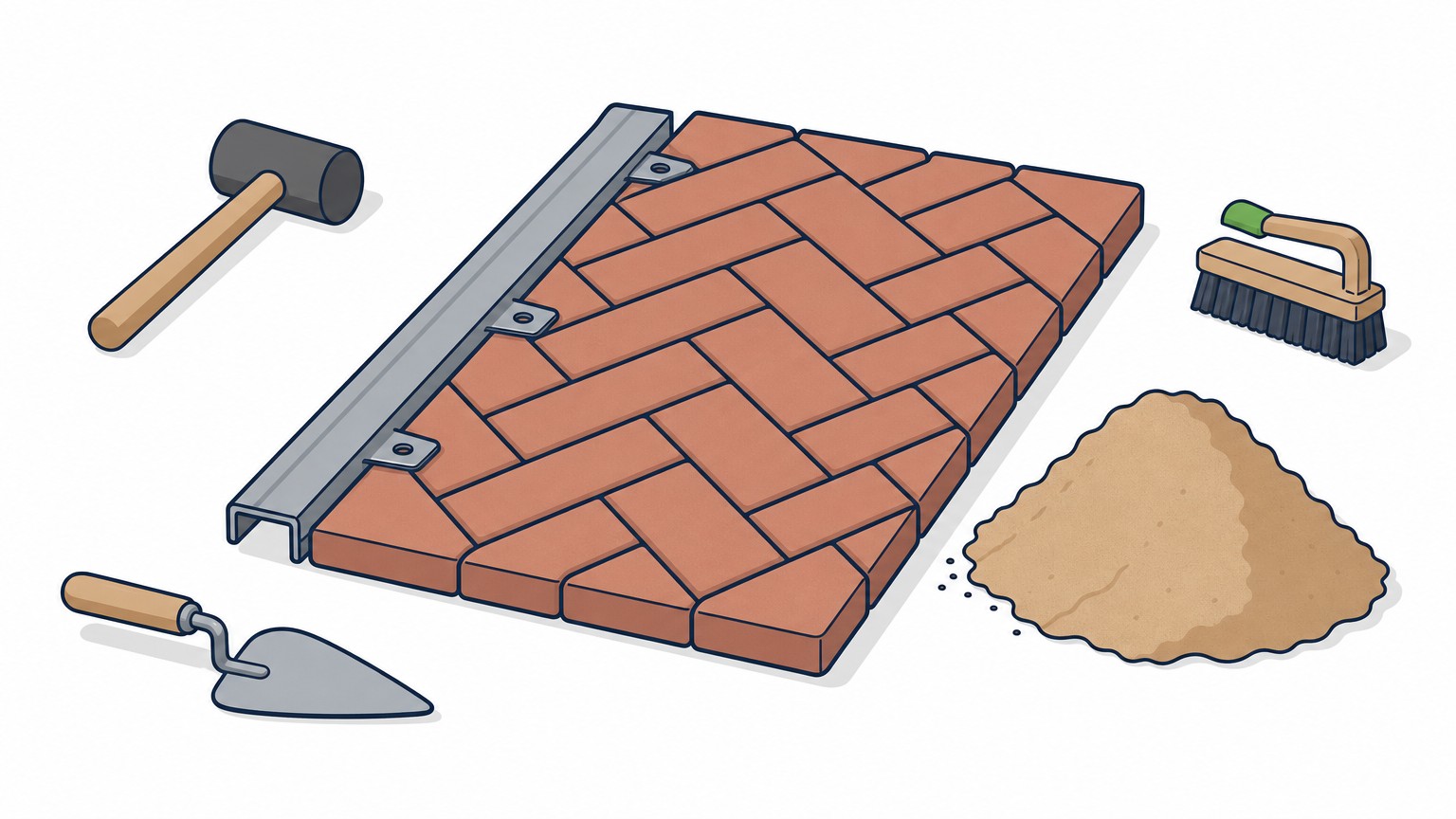
Clay brick keeps its color because the color runs through the unit, not just across the top.
What it is
Clay brick pavers are rectangular units made from fired clay in reds, tans, and charcoals. They are strong in compression and look best in a herringbone pattern , which also resists shifting under braking and turning wheels. Always get the manufacturer's vehicle rating , because some brick pavers are made for foot traffic only.
- Look for: a written rating for vehicular traffic.
- Look for: a herringbone or similar interlocking pattern for the drive lane.
Cost and upkeep
Brick usually costs more than concrete pavers and comes in fewer shapes. Upkeep is modest, but shaded stretches can grow algae or moss in Florida's humidity, so plan for an occasional pressure wash.
- Upfront cost: mid to higher tier.
- Upkeep: low. Wash shaded spots, refill joint sand, seal if you like a richer color.
Best for
Brick fits traditional, ranch, and brick-trimmed homes , and owners who dislike seeing color fade in the sun. It is a weaker match for a modern, large-format look.
- Choose it if long-term color stability matters most.
- Skip it if you want large-format slabs or the lowest bid.
3. Travertine pavers
Travertine is the choice for a natural-stone driveway that stays comfortable underfoot in the Florida sun. It looks high-end, but it is porous and softer than granite, so it needs a sealer and a thickness chosen for vehicles.
Travertine looks high-end and stays comfortable underfoot, but it needs sealing and a vehicle-rated thickness.
What it is
Travertine is a natural limestone in cream, ivory, and tan tones, usually sold with a tumbled or honed finish. It is popular on pool decks and patios, and some homeowners carry the same stone onto the driveway for a matching entry . Each piece varies, so ask for thicker, vehicle-suited pieces and view samples in full sun.
- Look for: thicker pavers suited to vehicle loads.
- Look for: a finish with enough texture to stay slip resistant when wet.
Cost and upkeep
Travertine sits in the higher cost tier . Its pores soak up oil and tire marks, so sealing at installation and resealing on schedule are not optional. Wipe up drips quickly rather than letting them set.
- Upfront cost: higher tier.
- Upkeep: seal at install, reseal on schedule, clean oil fast.
Best for
Travertine works when the driveway flows into a pool deck, courtyard, or entry in the same stone, and the daily load is passenger cars. If a work truck or trailer parks there every day, another material is the safer bet.
- Choose it if you want one continuous natural-stone look from drive to pool.
- Skip it if you want a low-maintenance surface or carry heavy loads daily.
4. Granite pavers
Granite is the pick for the longest-lasting stone paver driveway . It is dense and hard, takes heavy loads, and wears slowly.
Granite costs the most up front and wears the slowest.
What it is
Granite pavers are cut from dense igneous stone and sold as thin pavers, setts, or cobbles in grays, charcoals, and buffs. The weight makes it slow to set , which adds labor. Dark shades also absorb heat , so choose a lighter gray if bare feet or pets use the drive.
- Look for: consistent thickness so the surface sits flat.
- Look for: lighter shades if surface heat is a concern.
Cost and upkeep
Granite is the highest cost tier , because you pay for the stone, the freight, and slower setting. Upkeep is the lowest of the group. Dense stone resists stains, so you mainly manage joint sand and weeds .
- Upfront cost: highest tier.
- Upkeep: very low.
Best for
Granite suits owners who plan to stay in the home for decades and want an old-world cobble look. It also handles heavy vehicles well. If the budget is tight or you want bright colors, look elsewhere.
- Choose it if lifespan matters more than upfront cost.
- Skip it if you want the lowest bid or many color options.
5. Permeable interlocking concrete pavers
Permeable pavers are the pick when drainage and stormwater are your main concern. During Central Florida's summer storms, a driveway that absorbs water, rather than shedding it toward the garage or street, solves a real problem.
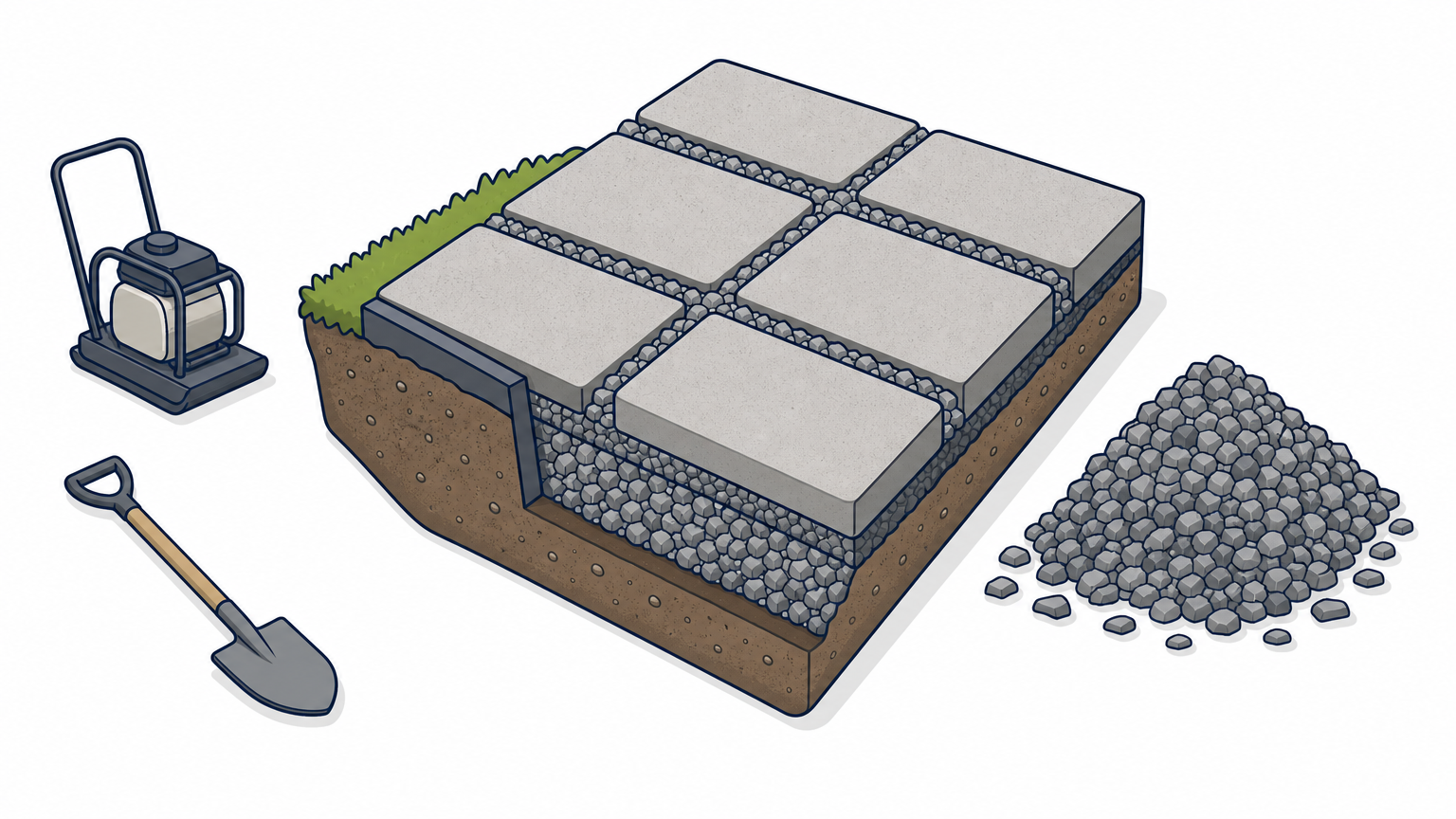
A permeable driveway handles rain through its joints and stone base, so the base design matters as much as the paver.
What it is
These are concrete pavers laid with wider joints filled with small, clean stone instead of fine sand. Beneath them sits an open-graded stone base that stores water and lets it soak into the soil. The surface looks like any paver driveway. The difference is in what you cannot see.
- Joint fill: small angular stone, not sand.
- Base: deeper layers of open-graded stone built for water storage.
Cost and upkeep
Permeable systems often cost more than standard concrete pavers because of the larger stone base . Joints can clog with soil, leaves, and fines, so plan for periodic vacuum sweeping and topping up the joint stone. Ask your city or county whether the design counts toward stormwater requirements for your lot.
- Upfront cost: mid to higher tier.
- Upkeep: moderate. Keep the joints clear.
Best for
Consider permeable pavers if water pools on your lot or runs toward the house, and your soil drains well. They only work when the ground below can absorb water, so have your contractor check how high the water table sits in the wet season.
- Choose it if drainage is the problem you are trying to fix.
- Skip it if groundwater sits near the surface during the rainy months.
6. Porcelain pavers
Porcelain pavers are the low-stain, colorfast option , but they are a niche pick for driveways. Most products are made for patios, pool decks, and walkways.
Porcelain belongs on walkways and patios first; use it on a driveway only when the maker rates it for vehicles.
What it is
Porcelain is dense fired ceramic with very low water absorption, sold in stone, concrete, and wood looks. Some thicker products are made for vehicles, but they may require a specific installation method , such as a particular base or a concrete slab. Follow the manufacturer's spec over general advice.
- Look for: a written vehicle load rating.
- Look for: the installation method the maker requires.
Cost and upkeep
Porcelain sits in the higher cost tier , and cutting it takes diamond blades, which adds labor. Upkeep is very low because the surface resists stains, mildew, and fading, and it usually needs no sealer.
- Upfront cost: higher tier.
- Upkeep: very low.
Best for
Porcelain fits modern homes, entry courts, and walkways that join the driveway in a matching look. A classic interlocking-paver driveway with easy repairs is a better match for heavy daily use.
- Choose it if you want a clean modern look and almost no maintenance.
- Skip it if you park heavy vehicles on it or want simple paver-by-paver repairs.
Pavers vs. concrete for a Sebring driveway
Pavers usually cost more than poured concrete up front, but they cope better with settling ground and are far easier to repair. Concrete wins on price and speed. The right call depends on your budget, your soil, and how long you plan to own the house.
Pavers cost more once and repair cleanly; concrete costs less once and shows every repair.
Side-by-side comparison
The table compares the two surfaces on the points that matter for a driveway.
| Factor | Stone pavers | Poured concrete |
|---|---|---|
| Upfront cost | Usually higher | Usually lower |
| Ground movement | Joints flex, units can be reset | Rigid slab, tends to crack |
| Repairs | Lift out and replace single units | Patches show, or sections get replaced |
| Appearance | Many colors, shapes, patterns | Plain, or stamped and stained |
| Drainage | Joints let some water through, permeable option | Sheds water, relies on slope |
| Installation time | Longer, laid by hand | Faster, but needs days to cure |
| Upkeep | Joint sand, weeds, optional sealing | Sealing and crack filling |
Florida's sandy soils and heavy summer rain put stress on whatever sits on top. A rigid slab over a washed-out edge cracks. A paver surface may dip, but a crew can lift the section, fix the base, and reset the same pavers.
When concrete is still the better call
Concrete makes sense when the budget is the deciding factor , when you want a plain surface, or when you need the job done quickly. A well-built slab with proper control joints and a compacted base can serve for many years.
Pavers do not forgive shortcuts either. A paver driveway on a thin base sinks and ripples, much as a slab on a bad base cracks. In both cases, the base decides the result , so compare contractors on how they build it, not only on which surface they sell.
What drives paver driveway cost and how to compare quotes
Paver driveway installation cost depends on area, material, base depth, site prep, and design complexity. The only reliable price is a written quote after someone walks your property. Per-square-foot figures from other cities do not account for Sebring soil, access, or your design.
A paver driveway quote is only as good as the scope it spells out.
What moves the price
Several line items push a quote up or down:
- Driveway area in square feet, including aprons and turnarounds.
- Paver material and thickness, as ranked above.
- Removal and hauling of the old driveway or turf.
- Base depth and any soft soil that needs extra work.
- Pattern complexity, borders, curves, and the cutting they require.
- Drainage work, edge restraints, and tie-ins to steps or walkways.
- Permits and HOA requirements.
- Sealing, which is often priced separately.
Worked example: a 600 square foot driveway
Take a typical two-car driveway, 20 feet by 30 feet, which is 600 square feet . With 3 1/8 inches of paver, 1 inch of bedding sand, and an 8 inch base, the crew digs down about 12 inches. The quantities look like this:
| Item | Approximate quantity |
|---|---|
| Soil and old surface removed (12 in deep) | about 22 cubic yards |
| Compacted base stone (8 in) | about 15 cubic yards |
| Bedding sand (1 in) | about 2 cubic yards |
| Common 4 by 8 inch pavers | about 2,700, before waste |
Loose stone shrinks when compacted, so the crew orders more than 15 cubic yards. The point is that excavation, hauling, and base stone are heavy, expensive work. A bid far below the others may be cutting exactly those items.
How to compare two quotes
Divide each quote by the square footage, then compare what is included. Suppose Quote A is $16,200 and Quote B is $13,800 for the same 600 square feet. That is $27 and $23 per square foot, a $2,400 gap . These numbers are arithmetic for illustration, not price estimates.
Now ask what explains the gap. Check base depth, haul-off, edge restraints, sealing, and permits line by line. If both quotes cover the same scope, the lower one wins. If not, you are comparing two different driveways.
How stone paver driveway installation works
A professional crew removes the old surface, builds a compacted stone base, sets bedding sand, lays and compacts the pavers, then locks the joints with sand. Nearly all of the effort goes into what ends up underground.
The base you never see decides whether the driveway stays flat.
What goes under driveway pavers
Pavers sit on a stack of layers, each with a job. Reading them top to bottom shows why shortcuts do not show up until a year or two later.
| Layer | Job | Typical depth |
|---|---|---|
| Pavers | Carry the load, set the look | about 3 1/8 in |
| Joint sand | Locks pavers together | fills the joints |
| Bedding sand | Levels the surface | about 1 in |
| Compacted aggregate base | Spreads load, drains | often 8 in or more |
| Geotextile fabric (optional) | Separates soil from base | between soil and base |
| Compacted subgrade | Stable foundation | native soil after topsoil is removed |
Pavers cannot go straight over dirt . The topsoil comes out, the soil underneath is compacted, and the stone base is built in layers. That is true for beginners and pros alike.
The steps in order
Here is the sequence a crew follows:
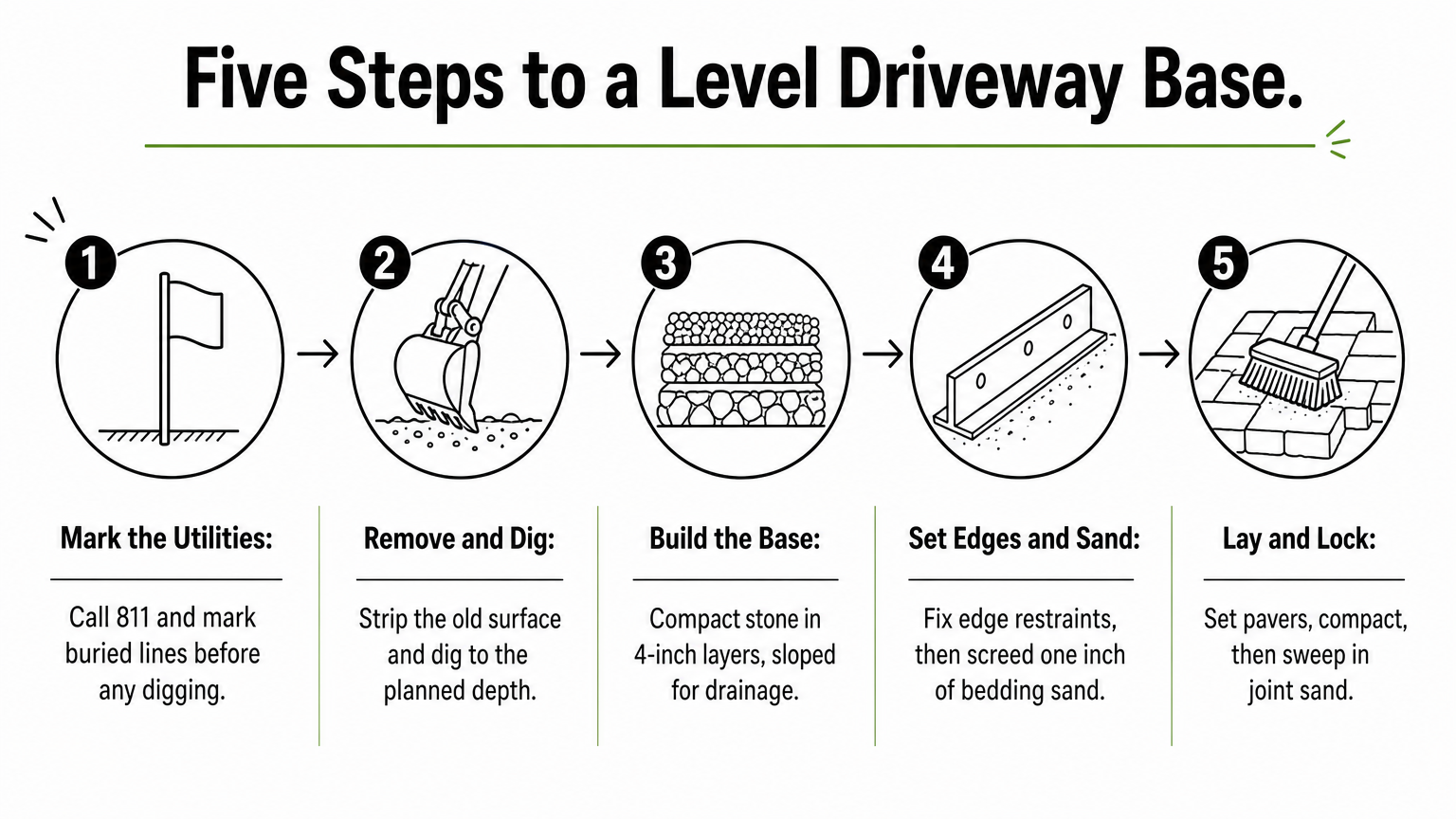
- Walk the site, measure, agree on a design, and have utilities marked by calling 811 before any digging.
- Remove the old driveway, sod, and topsoil, and dig to the planned depth.
- Compact the soil underneath and fix soft spots, adding fabric where the soil calls for it.
- Build the base in layers of about 4 inches, compacting each one and shaping a slight slope, at least a quarter inch per foot, so water leaves the surface.
- Install edge restraints so the borders cannot spread under traffic.
- Screed about an inch of bedding sand.
- Lay the pavers in the chosen pattern, cut the edges to fit, and compact the surface with a plate compactor.
- Sweep joint sand into the gaps, compact again, and sweep off the excess.
- Seal the surface if you want color protection. TWQ also seals existing pavers, new or older.
Can you install it yourself?
You can, but a driveway is a hard first project. The base work means moving about 22 cubic yards of soil, hauling in 15 or more of stone, and renting a heavy plate compactor . A weak base shows up months later as dips and wheel ruts, when it is costly to fix.
If you want to try pavers yourself, start with a small patio or path, where the load is light and mistakes are cheap. For the driveway, many homeowners hire a paver installation crew and keep the DIY for smaller projects.
How long it takes and when you can drive on it
Small, simple driveways can take a few days to a week, and larger or more intricate designs take longer. Summer rain delays are common in Central Florida, so build some slack into your schedule.
Compacted pavers carry weight quickly, but sealers and polymeric joint sand need cure time . Many installers ask you to stay off the surface for 24 to 48 hours. Follow your crew's written instructions for your materials.
How to hire a paver driveway contractor near you
Hire the contractor who explains base building in writing, holds the right license and insurance, and quotes the same scope as everyone else. Price comes last, once the scopes match. A local crew also knows Central Florida's soil and drainage.
Compare contractors on how they build the base, then on price.
Verify credentials first
Start with license and insurance . Ask what license the contractor holds, confirm it with the issuing agency, and request proof of liability insurance and workers' compensation coverage. Ask whether the crew members are employees or subcontractors, because that affects who answers for the work.
Training helps too. Installer certification through the Interlocking Concrete Pavement Institute is a good sign. Ask to see finished driveways that are at least a couple of years old, since that is when weak bases start to show.
Questions that expose shortcuts
These questions separate careful installers from fast ones:
- How deep is the base, and how is it compacted?
- Who removes the old driveway, and where does the debris go?
- What edge restraint do you use?
- How will water drain off the finished surface?
- Is sealing included, and when is it done?
- Who pulls permits and handles HOA approvals?
- What does the written warranty cover, and for how long?
- What is the payment schedule?
Get at least three written estimates for the same scope. Give each contractor the same material, pattern, and area so you can compare line by line.
What a clear estimate process looks like
Expect a walkthrough before a price. At TWQ, we offer a free estimate , schedule an on-site walkthrough before giving a written estimate, and respond to requests within one business day. We are licensed and insured, and we serve Sebring, Lake Placid, Avon Park, Okeechobee, Clewiston, Arcadia, Wauchula, and Lake Wales.
Whichever company you choose, expect the same sequence: walkthrough, measurements, written scope, then price. A quote handed over by phone with no site visit tells you nothing about your soil, slope, or drainage.
Your next step for a paver driveway
Pick the paver for how you live with it: concrete for most budgets, clay brick for steady color, travertine for a cooler natural look, granite for the longest life, permeable pavers for drainage, and porcelain only when it is rated for vehicles. Then pick the crew by how it builds the base, what the written scope includes, and whether the license and insurance check out.
Measure your driveway, decide which of these materials you want priced, and get written quotes for the same scope. That makes the numbers comparable and keeps the conversation on the work.
When you are ready for a local walkthrough, request a free paver driveway estimate from TWQ and we will look at your site before we put a number on paper.