
Paver Walkway Installation Cost: What You'll Pay per Sq Ft
The paver walkway installation cost is the total price to excavate a path, build a compacted base, set the pavers, and finish it with edge restraints and joint sand. In Florida, plan on $18 to $35 per square foot for a small walkway under 200 square feet, and $12 to $25 per square foot for larger paths. A typical 100-square-foot front walk lands between $1,800 and $3,500.
That figure is an installed price, not a materials price. It bundles labor, base aggregate, bedding sand, pavers, edging, and cleanup. It also runs higher per square foot than a patio, because walkways are small, narrow, and heavy on edges and cuts. Knowing what sits inside the number is how you tell a fair quote from one that quietly thins the base.
This guide explains why walkway pricing behaves the way it does, how to estimate your own total with a tape measure, and what moves the price up or down. It also compares pavers with poured concrete and DIY, and shows how to cut the bill without cutting the work underneath. TWQ is a family-owned landscaping company with more than 20 years of experience in Sebring and surrounding Central Florida, so the examples are framed for homeowners in Sebring, Lake Placid, Avon Park, and Okeechobee.
Why paver walkway pricing runs higher per square foot
A walkway costs more per square foot than a patio because fixed costs, such as equipment delivery, site setup, and cleanup, get spread over very little area. Once you understand that, you stop comparing a 100-square-foot path to a patio quote and wondering why you are being overcharged.
Typical price per square foot and per project
Installers in Florida advertise anywhere from $10 to $32 per square foot overall, depending mostly on the paver material. For walkways, the size of the job decides which part of that range you land in. The table below applies three size tiers to common path dimensions. The low end assumes basic concrete pavers in a running bond pattern on an easy site. The high end assumes natural stone, a more complex pattern, or harder access.
| Walkway | Layout | Rate per sq ft | Estimated installed total |
|---|---|---|---|
| 60 sq ft | 3 ft × 20 ft | $18 to $35 | $1,080 to $2,100 |
| 100 sq ft | 4 ft × 25 ft | $18 to $35 | $1,800 to $3,500 |
| 150 sq ft | 3 ft × 50 ft | $18 to $35 | $2,700 to $5,250 |
| 200 sq ft | 4 ft × 50 ft | $14 to $28 | $2,800 to $5,600 |
| 400 sq ft | 4 ft × 100 ft | $14 to $28 | $5,600 to $11,200 |
| 1,000 sq ft | 10 ft × 100 ft | $12 to $25 | $12,000 to $25,000 |
A 400-square-foot walkway is a long garden path or a wraparound route, and a 1,000-square-foot run is really driveway scale. Driveways need a thicker base to carry vehicle weight, so expect them to price at the top of their tier.
Why small jobs cost more per foot
The first reason is fixed costs. Hauling a plate compactor and a pallet of base material to your yard costs about the same for a 60-square-foot path as for a 300-square-foot patio. Divide that by fewer square feet and the per-square-foot rate jumps.
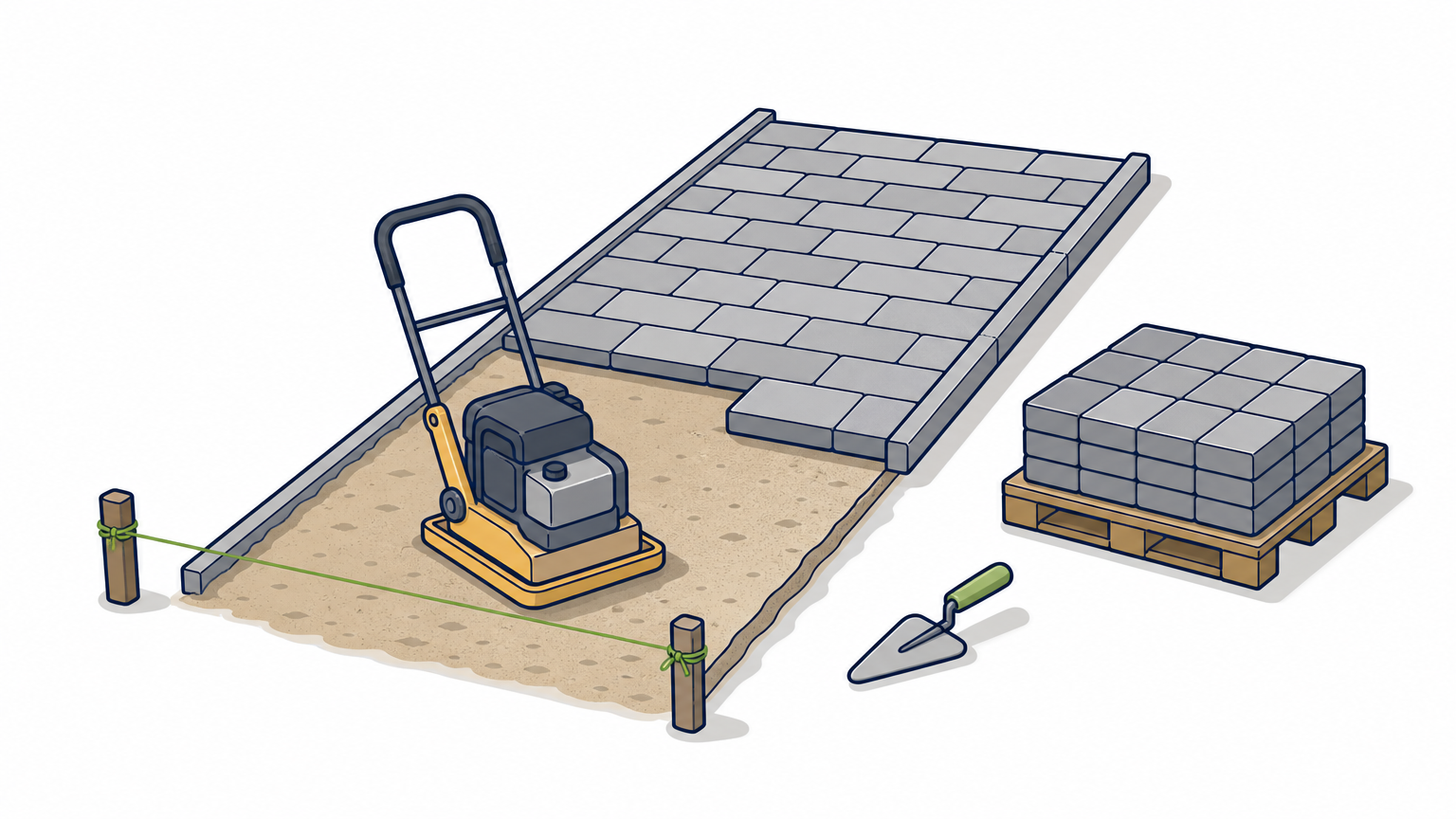
The second reason is geometry. A walkway has far more edge for its area than a patio. A 4 ft × 25 ft path has 58 feet of perimeter for 100 square feet, or 0.58 feet of edge per square foot. A 20 ft × 20 ft patio has 80 feet of perimeter for 400 square feet, or 0.2. More edge means more cut pavers, more edge restraint, and more hand finishing, and every one of those adds labor hours that a wide open patio avoids.
A walkway is priced like a small, edge-heavy job, so judge your quote against walkway rates and not patio rates.
How to estimate your paver walkway cost
You can build a reliable ballpark for your walkway in about ten minutes with a tape measure and the rates above. The goal is not to replace a written quote. It is to know roughly what the quote should say before anyone visits your property.
Measure and calculate your own number
Follow these steps in order:
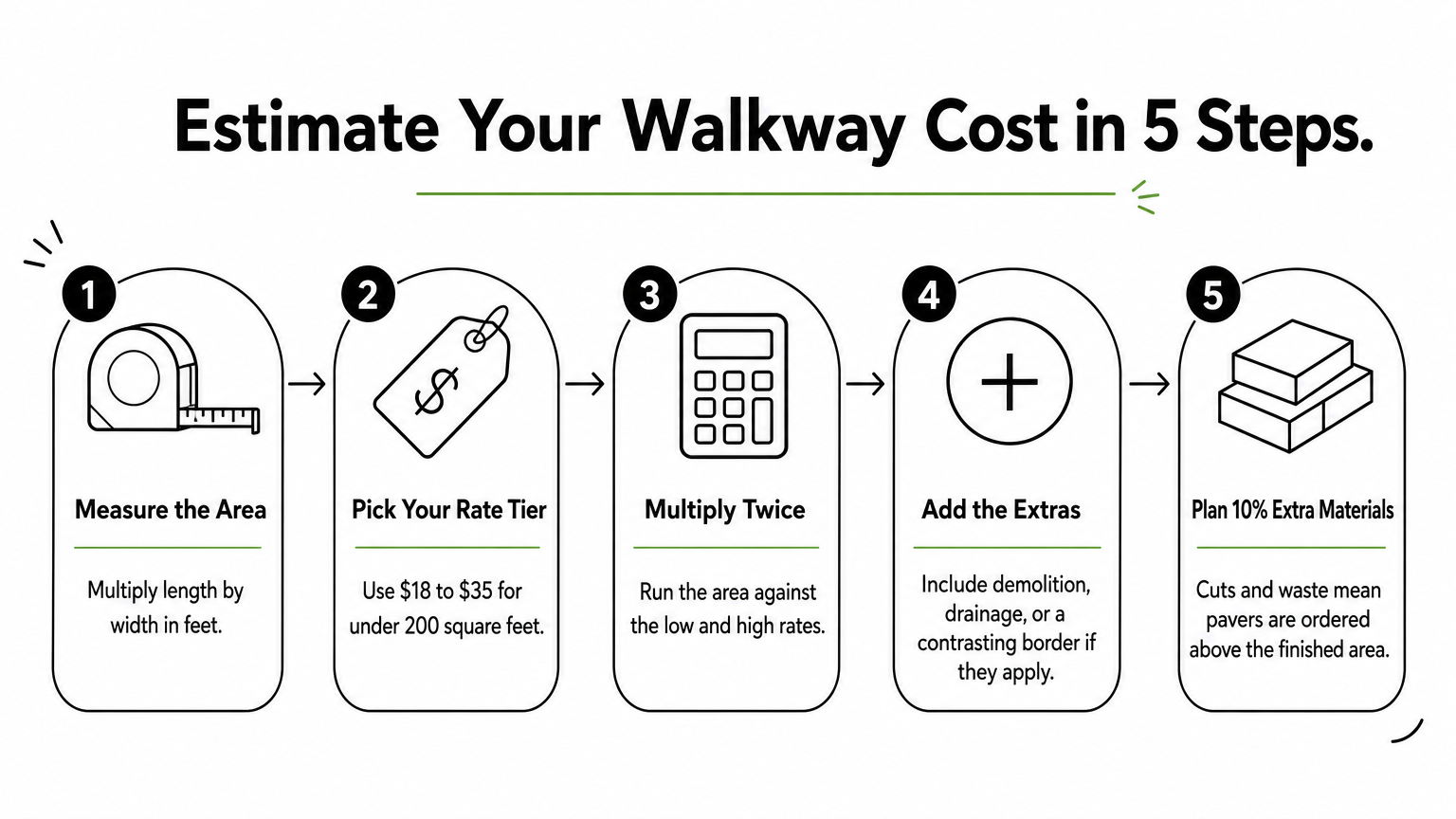
- Measure the finished area. Multiply length by width in feet. For a curved path, measure the length along the centerline and multiply by the average width.
- Pick your rate tier. Use $18 to $35 for under 200 square feet, $14 to $28 for 200 to 500, and $12 to $25 beyond that.
- Multiply twice. Run the area against the low rate and the high rate to get your range.
- Add the extras that apply. Removing an old walkway runs $2 to $5 per square foot, drainage work runs $500 to $2,500, and a contrasting border runs $3 to $8 per linear foot.
- Plan materials at 10% over. Contractors price the finished area, but cuts and waste mean pavers are ordered above it. Waste typically runs 5% to 10%, and more for angled patterns.
Here is a worked example. A 3 ft × 40 ft path is 120 square feet. Basic concrete pavers in the small-job tier, at $18 to $28 per square foot, come to $2,160 to $3,360. If a cracked concrete walk must come out first, add $240 to $600 for demolition and disposal. Your budget range is $2,400 to $3,960 .
Where the money goes
Those totals cover several separate pieces of work. This is a typical split of the $18 to $28 rate for the 120-square-foot example, so you can see what a quote should contain.
| Component | Per sq ft | On 120 sq ft |
|---|---|---|
| Excavation, compacted base, sand bedding | $4 to $6 | $480 to $720 |
| Concrete pavers | $6 to $9 | $720 to $1,080 |
| Laying, cutting, final compaction | $6 to $9 | $720 to $1,080 |
| Edge restraints and polymeric sand | $1 to $2 | $120 to $240 |
| Delivery, setup, cleanup | $1 to $2 | $120 to $240 |
| Total | $18 to $28 | $2,160 to $3,360 |
Labor across the whole job typically runs $4 to $11 per square foot, depending on size, complexity, and site prep. Notice that the base line is small money compared with the total. It is also the line a low quote cuts first.
How to check a contractor quote
Divide the quote by your square footage and compare the result with your tier. If it falls inside, the price is plausible. Then check that the quote spells out the work:
- Excavation depth and a base of roughly 4 to 6 inches of compacted gravel, laid in layers
- About 1 inch of sand bedding under the pavers
- Edge restraints and polymeric sand, listed separately
- Removal and disposal , if an old surface is coming out
- Permits or HOA approval , and who handles them
A quote far below your range that lumps everything into one line usually saves money by thinning the base. A quote above it is not automatically inflated, since slopes, tight access, and patterns can each add 10% to 30%. Ask which of those the price accounts for. At TWQ, a team member walks the site before writing the estimate, which is how drainage and access show up in the number before work starts.
A per-square-foot figure tells you whether a quote is plausible, and the itemized base tells you whether it is sound.
What moves the price of a paver walkway installation
Material, pattern, width, and site conditions decide where your walkway lands between the low and high end of its range. Of these, material is the biggest single lever, and site conditions are the one homeowners underestimate.
Paver material
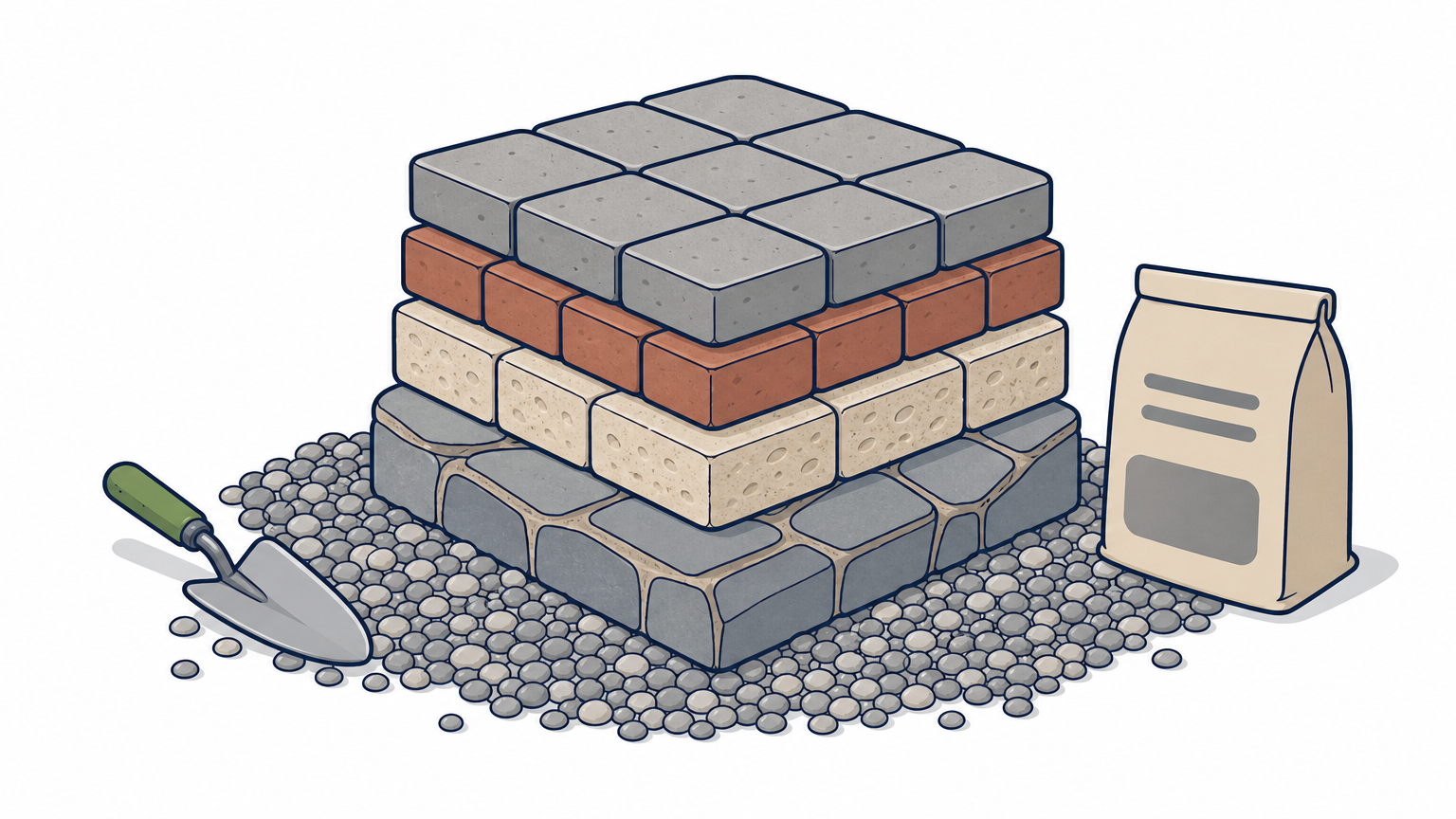
Material choice drives most of the spread between a basic and a premium path. These are installed prices per square foot, labor included:
| Material | Installed cost per sq ft | What to know |
|---|---|---|
| Concrete pavers | $12 to $22 | Most common choice; tumbled finishes add $2 to $4 |
| Interlocking pavers | $12 to $25 | Individual units lift out for repair |
| Brick pavers | $15 to $30 | Color runs through the unit; heavier to ship |
| Permeable pavers | $18 to $35 | Premium of $6 to $10 over standard; handles drainage |
| Natural stone (flagstone, travertine, bluestone) | $25 to $65 | Travertine stays cooler underfoot but is porous |
On a sunny Florida path, travertine's cooler surface is a real comfort for bare feet, but you pay for it in material and sealing. For most homeowners, concrete pavers deliver the best balance of cost and durability, and natural stone works well as an accent border or entry landing.
Pattern, shape, and width
Running bond and stacked patterns install fastest because cuts are minimal and repetitive. Herringbone adds 10% to 15% to labor and pushes waste from about 5% toward 10% or more. Circular and fully custom layouts can double labor time, since each paver is measured and cut individually.
Width matters more than people expect. Each extra foot of width on a 40-foot path adds 40 square feet, or $720 to $1,120 at the $18 to $28 concrete rate. A 3-foot path is a common minimum, while 4 feet lets two people walk side by side. Decide on width before you ask for quotes, because it changes every number.
Site conditions and access
Sandy soil is common across Central Florida. It drains well and excavates easily, but it still needs layered compaction, and clay pockets or a high water table call for deeper base material. Extra base work can add $2 to $4 per square foot. If water pools along your path after summer storms, budget for drainage before pavers go down.
Access also shows up in the quote. If a skid steer can reach the path, labor moves fast. If materials must be hand-carried through a side gate, labor rises by roughly 20% to 30%. Slopes and tricky layouts can add 15% to 30% to baseline figures.
Soil, slope, and access can move your price more than the paver itself, which is why a walkthrough beats any online calculator.
Paver walkways versus concrete and DIY: what each costs
Poured concrete is cheaper up front than pavers, and a DIY walkway is cheaper than a hired one on materials alone. Both comparisons look different once you count repairs, tools, and your own time.
Pavers versus poured concrete
Poured concrete typically runs $6 to $12 per square foot installed, against $12 to $25 for pavers in broad Florida ranges. On a 120-square-foot path, that is $720 to $1,440 for concrete and $1,440 to $3,000 for pavers, before any small-job premium on either.
The gap narrows over time because of how each one fails. A cracked concrete slab usually means replacing a section, while a settled paver corner caught early often costs $200 to $400 to relay, since individual units lift out without disturbing the rest. If you want the lowest price today and a plain gray surface, concrete wins. If you want a path you can repair in small pieces and style with color and pattern, pavers are worth the premium.
Doing it yourself
A DIY walkway makes sense only for small paths. Materials for concrete pavers, base gravel, and sand run roughly $4 to $7 per square foot, so 100 square feet costs $400 to $700. Add $300 to $500 for tool rental, including a plate compactor at $80 to $150 per day, and your out-of-pocket total is $700 to $1,200. A professional install of the same path runs $1,800 to $3,500.
The base is the catch. A 100-square-foot path with a 5-inch base needs about 1.5 cubic yards of aggregate, which is roughly 2 tons you must haul, spread, and compact in layers. Add soil disposal, bedding sand, and the risk of ordering the wrong quantity, and the real savings shrink. Poor compaction is the usual reason DIY paths settle within a season or two, and a redo costs more than hiring the job in the first place.
Do it yourself only if the path is short, the ground is level, and you are willing to compact the base properly.
How to lower your walkway cost without weakening the base
You can cut a walkway quote by $2 to $5 per square foot through material, design, and timing choices. You cannot safely cut it by skipping base depth, compaction, or drainage, because those savings come back as repair bills.
Choices that save real money
- Choose concrete pavers for the main surface and use natural stone only as a border or entry accent. On a mixed project, this alone can save thousands.
- Keep the pattern simple. Running bond means fewer cuts, less waste, and fewer labor hours than herringbone.
- Trim the width or straighten the route. A 3-foot path costs a quarter less than a 4-foot one of the same length, and gentle curves cost less than tight ones.
- Bundle projects. Combining a walkway with a patio or driveway spreads setup and equipment costs across more square feet.
- Schedule in the off-season. Late fall and winter often give contractors open dates and more room on price.
- Clear the site yourself. Moving planters, trimming back plants, and clearing debris before the crew arrives removes small line items.
- Compare itemized quotes. Two or three written quotes show where prices truly differ, not just where the totals do.
Savings that cost you later
Be wary of savings that come from the base. A quote that saves $1,000 on compaction can turn into $1,500 or more in reconstruction within two seasons, which leaves you paying twice for one walkway. Skipped edge restraints let pavers creep sideways, and ignored drainage lets water undermine the base.
Plan for upkeep too. Concrete pavers hold their appearance best when resealed every 3 to 5 years, and fresh joint sand keeps weeds and washout from eating into the base. Ask whether sealing is included in your quote or priced separately, so the full cost of ownership is clear from day one.
The cheapest walkway is the one you only pay for once, so cut width, pattern, and material before you ever cut the base.
Setting your walkway budget
Plan on $18 to $35 per square foot for a small paver walkway, falling toward $12 to $25 per square foot as the path grows. Measure your area, choose a material, add any demolition or drainage, and you have a range you can defend. Then use the itemized checklist to confirm every quote includes a proper base, edge restraints, and joint sand.
A fair price is one that fits your range and shows its work. If it is far below, ask what was left out. If it is above, ask which site factors explain the gap. Either way, a walkthrough of your yard will settle what a calculator cannot.
When you are ready for a number tied to your actual property, request a free estimate from TWQ. We are licensed and insured, we walk the site before writing the estimate, and we respond to requests within one business day.