
7 Tips for Finding Irrigation Sprinkler Repair near Me
A sprinkler head stuck open, a dry patch spreading across your lawn, or a water bill that jumped for no clear reason all point to the same fix: you need someone who can diagnose and repair your system fast. Searching irrigation sprinkler repair near me usually turns up a long list of names, and picking the wrong one means callbacks, patched leaks that leak again, or a system that never quite gets balanced right.
This article gives you a practical way to sort through those options. You'll learn what separates a reliable local technician from someone just passing through with a truck and a few tools, and how to spot the signs of solid, lasting workmanship before you sign anything.
Below are seven tips for finding the best irrigation repair near me , covering licensing, experience with systems like yours, response times, and the kind of customer reviews that actually tell you something useful. If you're in Sebring or anywhere across Central Florida, these tips will help you find a company, like TWQ, that treats your irrigation system as part of a bigger picture: a healthy, well-maintained landscape.
1. Choose a full-service landscape and irrigation provider
Why it matters
A sprinkler system doesn't work in isolation from the rest of your yard. Soil type, turf variety, plant beds, and slope all affect how water needs to be distributed, and a technician who only knows sprinkler valves misses that bigger picture. Choosing a full-service landscape provider means the person fixing your irrigation also understands how your lawn drains, where your root zones sit, and why one zone might be overwatering while another stays bone dry. This matters most when your problem isn't a single broken head, but chronic brown patches or runoff that a narrow, sprinkler-only repair outfit won't connect back to the landscape itself.
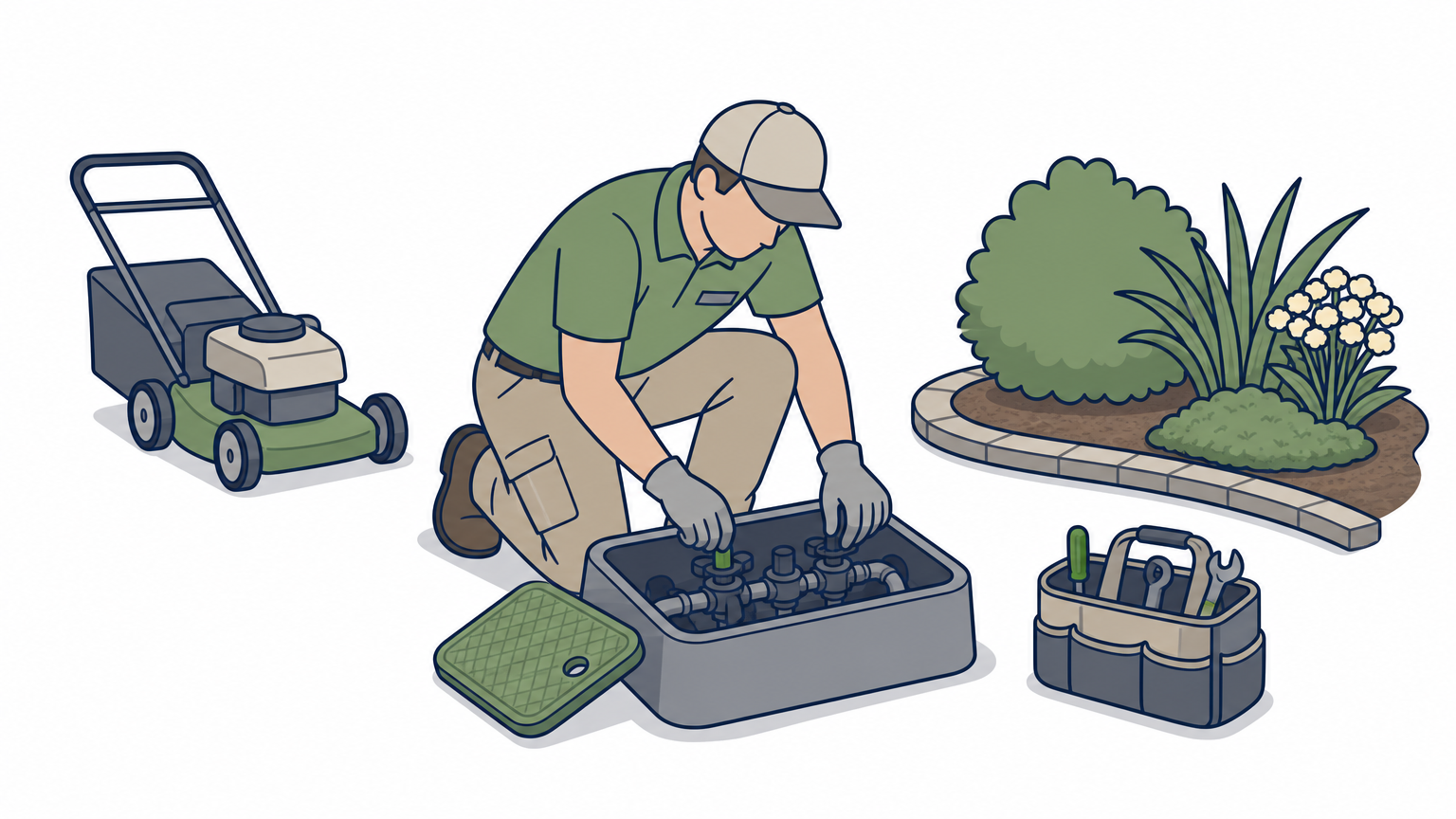
A technician who only touches pipes and valves can fix a leak, but a landscape partner fixes the reason your yard needed that leak fixed in the first place.
What to look for
Search for companies that pair irrigation repair with lawn care and mowing, hardscape, and ongoing maintenance under one roof. That combination tells you the company thinks about your property as a whole system, not a one-off service call. Look for:
- A service list that includes irrigation design and installation, and repair alongside mowing, fertilization, and property clean-ups
- Technicians who ask about your turf and plant health, not just your sprinkler zones
- A willingness to walk the whole property, not just the broken head you called about
- Local experience with Florida's sandy soil, drainage patterns, and dry-season stress on lawns
Questions to ask
Before you hire anyone, ask a few pointed questions to see whether they're set up to handle your yard as a whole, not just the leak in front of them:
- Do you offer ongoing landscape maintenance in addition to irrigation repair?
- Can you explain how my system's watering schedule affects my turf health?
- Will the same team handle irrigation, mowing, and any hardscape work I might need later?
- What happens if the irrigation issue turns out to be a bigger drainage problem in my landscape?
Companies like TWQ, which cover irrigation, lawn care, and paver patios and retaining walls under a single crew, tend to catch problems that a narrow repair-only company would miss entirely. That's the real advantage of going full-service: fewer callbacks, and a yard that actually holds up between visits.
2. Verify licensing, insurance, and local experience
Why it matters
Anyone can buy a truck and call themselves an irrigation repair company, but licensing and insurance protect you if something goes wrong on your property. An unlicensed technician who nicks a gas line or damages a neighbor's fence leaves you exposed to the cost, not them. Local experience matters just as much, since Florida's sandy soil, high water tables, and county-specific water restrictions all shape how a system should be designed and repaired.
Skipping the license check is the fastest way to turn a small sprinkler fix into a costly liability.
What to look for
Confirm the company carries current state licensing and general liability coverage, and ask how long they've worked in your specific county. A crew that's repaired systems across Sebring, Lake Placid, or Avon Park already knows the local water management rules and soil quirks that trip up out-of-area contractors. Look for:
- A licensed and insured business, not just a subcontractor
- At least a few years of hands-on work in your region
- Familiarity with your local water district's watering restrictions
Questions to ask
Ask these directly, and don't settle for vague answers:
- Can you provide proof of your current license and insurance?
- How many years have you worked on irrigation systems in this county?
- Are you familiar with our local water restrictions and permitting rules?
TWQ has spent over two decades serving Central Florida properties, which means the crew already understands the region's soil and water rules before they ever touch your valves.
3. Check online reviews and local reputation
Why it matters
Reviews tell you what a sales pitch never will: whether the work actually held up after the truck left. A company can promise fast response times and fair pricing, but online reviews reveal whether they showed up on time, fixed the problem the first visit, and treated your yard with care. Searching for the best irrigation repair near me should always include a pass through Google reviews, not just a glance at the star rating.
A five-star rating means little without reading what customers actually experienced.
What to look for
Don't stop at the overall score. Read the actual comments, especially ones that mention repeat visits, communication, or how the crew handled unexpected problems. A strong local reputation shows up as a pattern, not a single glowing review. Look for:
- Recent reviews, not just ones from years ago
- Comments mentioning specific services like sprinkler heads, valves, or zone repairs
- Responses from the company addressing negative feedback professionally
- Mentions of the same technicians or crew names across multiple reviews
Questions to ask
Bring your findings into the conversation instead of hiding them:
- Can you point me to recent customer reviews for irrigation work specifically?
- How do you handle a situation where a customer isn't satisfied with a repair?
- Do you have references from properties similar to mine?
A company confident in its reputation will welcome these questions instead of deflecting them.
4. Ask about warranties on labor and parts
Why it matters
A repair that fails again in three months isn't really a repair, it's a delay. A solid warranty on labor and parts tells you the company stands behind its own work instead of hoping you won't notice a repeat leak until the invoice clears. Irrigation systems take a beating from Florida's heat, sandy soil, and heavy summer rain, so parts that aren't installed correctly the first time tend to fail fast. Without a warranty, you're the one paying twice for the same fix.
If a company won't guarantee its own repair, that's your first sign to keep looking.
What to look for
Ask for the warranty terms in writing before work begins, not after the invoice arrives. Look for:
- A clear timeframe covering both labor and replacement parts, typically 30 to 90 days at minimum
- Written documentation you can reference later if a problem resurfaces
- No hidden exclusions that quietly void coverage for common failures
- A policy that applies to sprinkler heads, valves, and controller repairs alike
Questions to ask
Get specifics before you commit to a repair date:
- What's covered under your warranty, and for how long?
- Is the warranty in writing, or just a verbal promise?
- What happens if the same zone fails again next month?
- Do warranty repairs come with an additional service fee?
A company that answers these plainly, without hedging, is one that expects its repairs to hold up.
5. Confirm they service all sprinkler brands and systems
Why it matters
Your irrigation system might be a mix of Rain Bird heads, a Hunter controller, and valves installed a decade ago by someone else entirely. A technician who only knows one manufacturer's parts often ends up guessing, or worse, replacing a working component just because it's unfamiliar. Confirming a company handles all sprinkler brands and systems before you book them saves you from a repair that only half-solves the problem, or a mismatched part that fails within weeks.
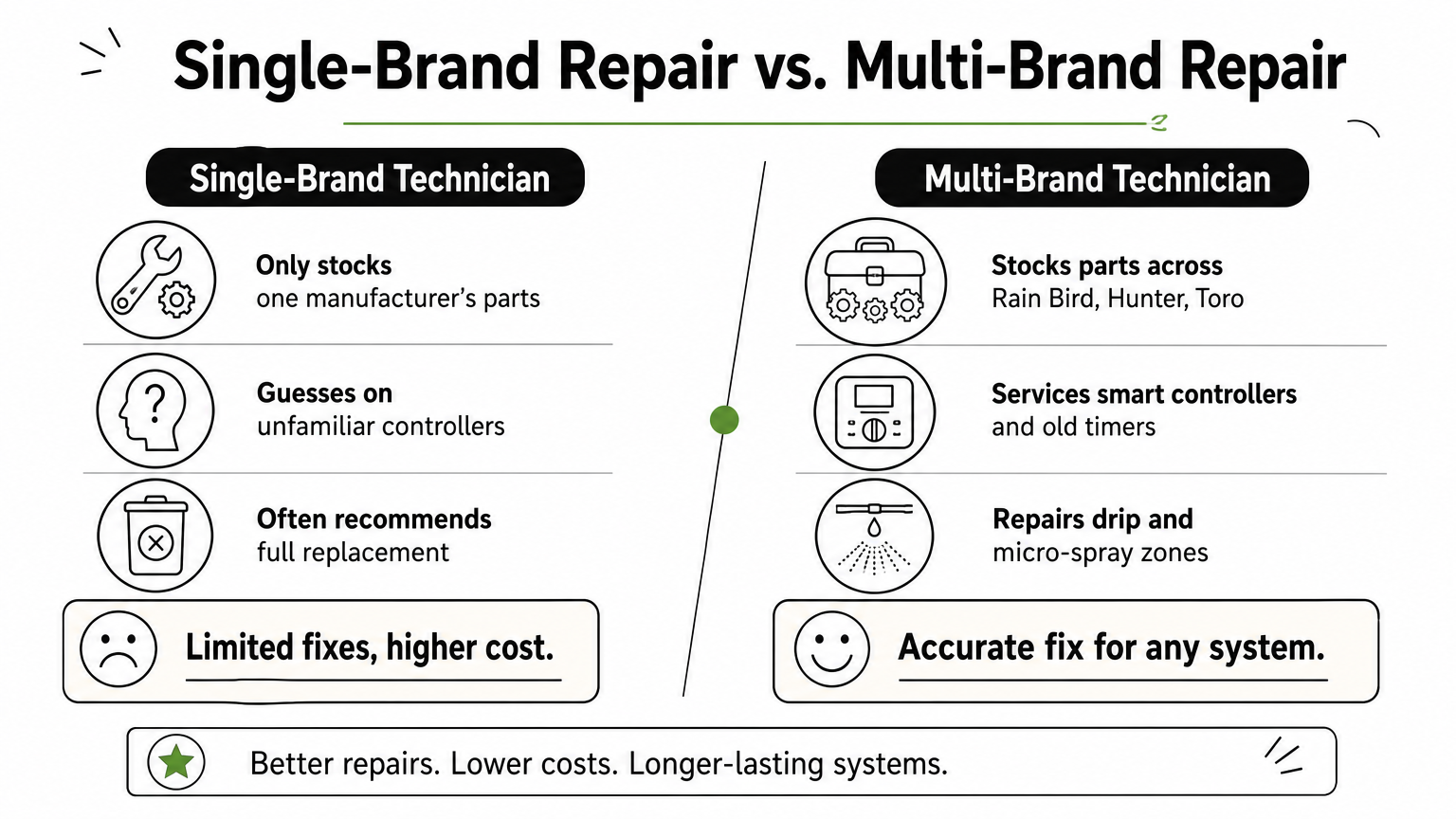
A repair company that only knows one brand will always find a reason to blame the parts it doesn't stock.
What to look for
Good technicians can diagnose and repair whatever is already in your yard, not just the systems they prefer to sell. Look for:
- Experience across major brands like Rain Bird, Hunter, Toro, and Rain Master
- Comfort working with both smart controllers and older manual timers
- Drip irrigation and micro-spray knowledge, not just rotor and spray heads
- A stocked truck with common parts across brands, not just one supplier's line
Questions to ask
Ask these before scheduling, especially if you're not sure what brand your system uses:
- Do you work on all sprinkler brands, or only certain manufacturers?
- Can you service my existing controller, or will you push a full replacement?
- Have you repaired drip or micro-irrigation zones like mine before?
A company that answers yes across the board, without steering you toward an unnecessary upgrade, is one you can trust with whatever hardware is already buried in your yard.
6. Compare pricing with a written estimate
Why it matters
Verbal quotes leave too much room for surprises once the work is done. A written estimate spells out exactly what you're paying for, whether that's a single sprinkler head swap or a full valve replacement, before anyone touches your yard. Without one, you're relying on memory when a final bill shows extra charges for parts or labor nobody mentioned upfront.
A number given over the phone isn't a price, it's a guess you'll pay for later.
What to look for
A fair estimate breaks down labor, parts, and any trip or diagnostic fees separately, so you can see where the money actually goes. Look for:
- An itemized breakdown of parts and labor, not a single lump total
- Clear mention of diagnostic or trip fees before the technician arrives
- A price that matches what was discussed during the initial call
- No pressure to sign same-day without time to compare against another quote
Questions to ask
Get the numbers in writing before you agree to anything:
- Can you send a written estimate before starting any repair?
- Does this price include parts, labor, and any service fees?
- What happens if you find additional damage once the system is open?
- How does your pricing compare for similar repairs in this area?
Comparing two or three written estimates side by side takes an extra day, but it protects you from paying premium prices for a repair that should cost far less.
7. Look for seasonal check-ups and ongoing maintenance
Why it matters
A one-time repair fixes today's problem, but Florida's growing season shifts fast, and a system tuned for spring rain runs wrong by August. Seasonal check-ups catch clogged heads, drifting spray patterns, and controller settings that no longer match the weather before they show up as a dead patch of St. Augustine grass. Pairing repair work with ongoing maintenance means someone's already watching your system when the next problem starts, instead of waiting for you to notice a spike in your water bill.
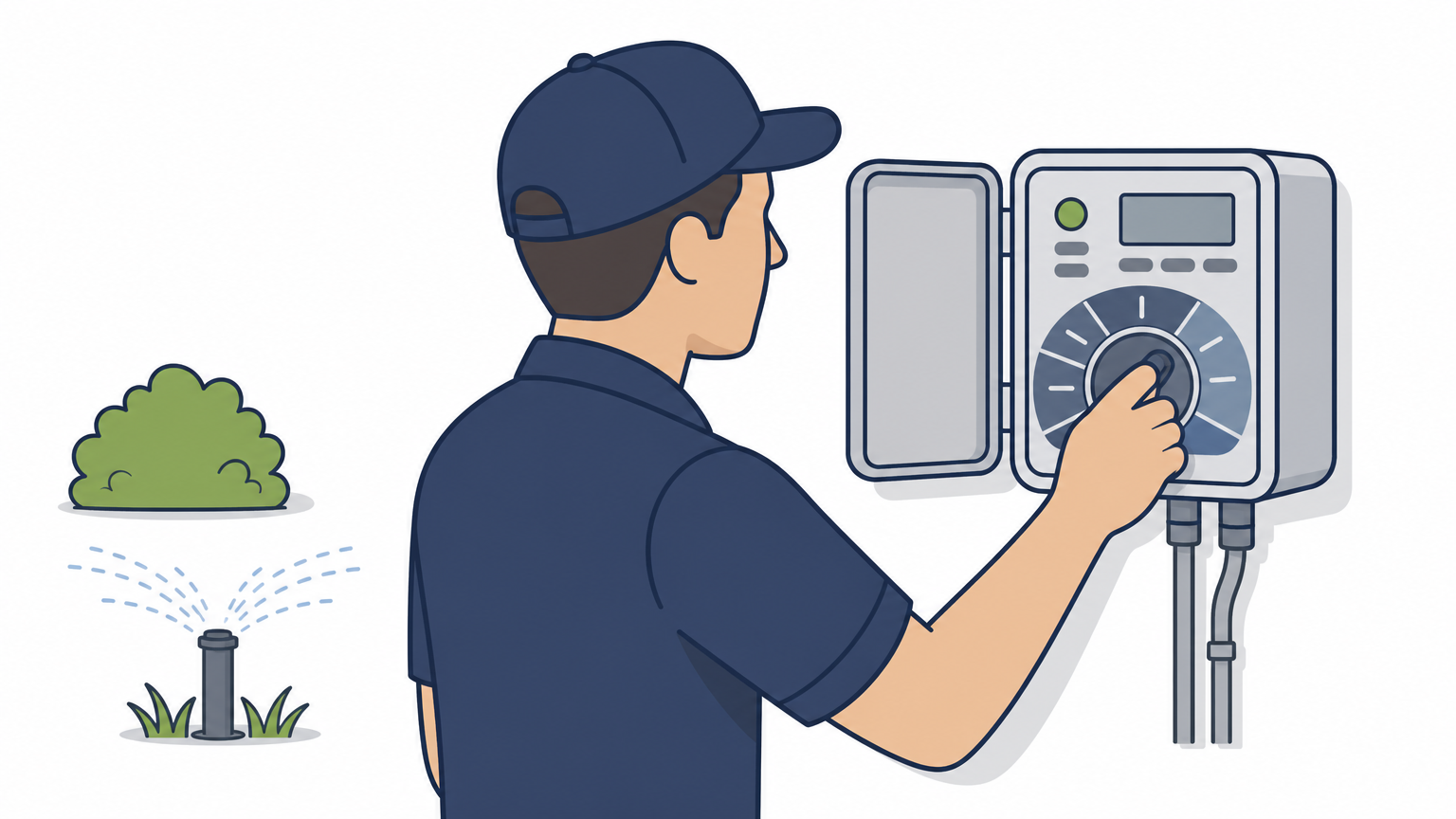
A system that only gets attention when it breaks will keep breaking at the worst possible time.
What to look for
Favor companies that offer a maintenance plan alongside repair work, not just a single invoice and a handshake. Look for:
- Scheduled seasonal inspections, ideally tied to Florida's wet and dry seasons
- Controller adjustments based on rainfall and local watering restrictions
- Documentation from each visit, not just a verbal "looks fine"
- Bundled pricing for maintenance versus paying full price per visit
Questions to ask
Ask these to see whether they're thinking past the current repair:
- Do you offer a maintenance plan that includes seasonal check-ups?
- Will you adjust my controller settings as the seasons change?
- How often should my system be inspected given my yard's size?
- What's included in ongoing service versus a one-time repair?
TWQ's recurring sprinkler system wet checks keep systems tuned year-round, so small issues get caught long before they turn into a dead lawn or a surprise water bill.
Finding the right fit for your yard
Seven tips, one goal: stop hiring based on whoever answers the phone first. A licensed irrigation repair company that also understands your soil, your turf, and your local water rules will always outlast a truck-and-tools operation that only shows up when something breaks. Reviews, warranties, brand knowledge, written estimates, and seasonal check-ups aren't extra steps, they're how you avoid paying for the same repair twice.
Your search for irrigation sprinkler repair near me should end with a company that treats your yard as one connected system, not a list of separate problems. That's the difference between a quick patch and a lawn that actually holds up through Florida's wet and dry seasons alike.
If you're in Sebring or anywhere across Central Florida, reach out to TWQ for sprinkler system repair in Sebring FL: a straightforward look at your system, honest pricing, and a crew that sticks around long after the first repair.